
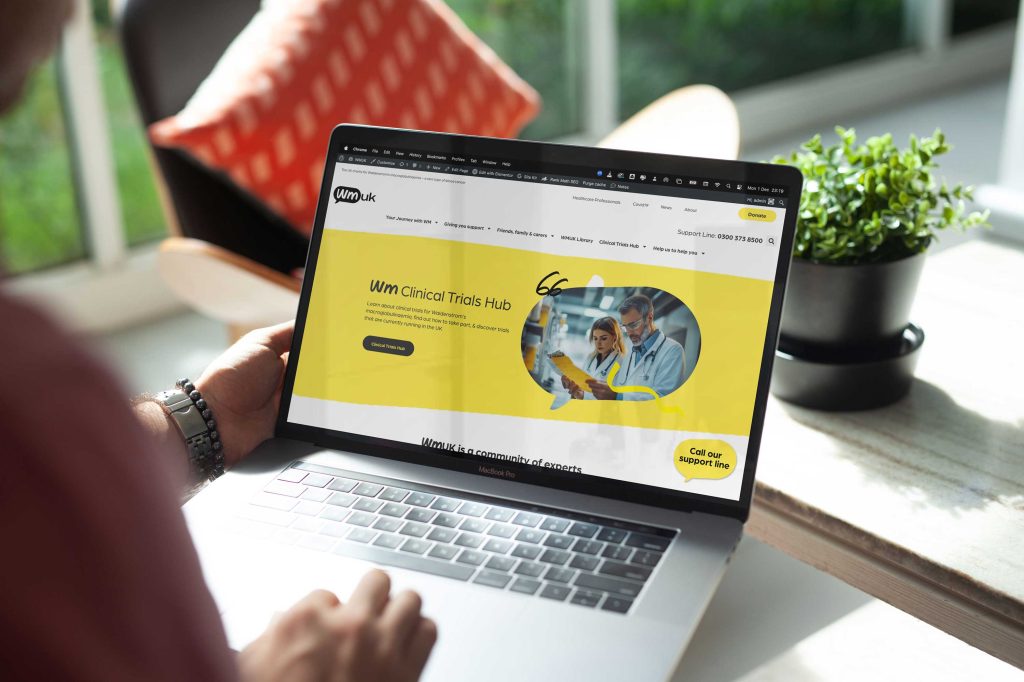
Waldenstrom’s macroglobulinaemia is a rare blood cancer, with between 350 people in the UK diagnosed with it every year. It is incurable, but its symptoms can often be managed with treatment, and there’s about 4,000 people in the UK currently living with it.
Clinical trials for rare, incurable cancers can be a genuine treatment option. But finding relevant clinical trials while they’re recruiting can be challenging for patients because they are so few & far between, typically scattered across multiple registries, written for clinicians, and with inconsistent formats.
WMUK wanted to give the UK’s WM community a single, structured, easy to use place to look, when asking “is there anything else I can try?”
We built the the only clinical trials hub focussed on Waldenstrom’s macroglobulinaemia, and it lives within the WMUK website. We integrated it with Google Sheets so the charity’s team could easily make updates.
Accuracy matters doubly here, because for patients a trial listing is not information. It can be hope. And because accuracy matters for SEO (EEAT & YMYL) when talking about medical data.
The same principle as every integration we build: the right system for a charity is the one its team can own. A bespoke trials database would have made every update more fiddly, more prone to human errors filling every field, and require someone to learn a new process.
If all the team already knows how to use a spreadsheet, then it makes sense to work with their existing skills, so it is easier for them to keep the data updated.
For data integrity, the structured spreadsheet includes options like a date picker, and drop-downs for the trial phase, wether it is recruiting, the region to ensure the consistency & accuracy that matters to the patients.

The scale of the audience makes the numbers remarkable. Around 4,000 people live with WM in the UK, and between 350 and 400 are diagnosed each year (WMUK, 2026). Against that population, the hub’s first 12 months delivered 27,501 appearances in Google search results and 382 visits
from search, across 428 distinct search queries (Google Search Console, October 2025 to October 2026).
The queries show the hub reaching people at their moment of need. Searchers arrive via the codenames of specific trial drugs, bexobrutideg (NX-5948), sonrotoclax, NUC-7738, JNJ-75348780, with hub pages ranking in or near the top ten for them. These are searches made by patients, families and clinicians who already know what they are looking for and could not previously find it in one place.
The hub is UK-focused, but its audience is not. Search impressions came from 98 countries, with almost half of the located impressions arising outside the UK and the United States the largest single source. People with a rare cancer look wherever the information exists, and for WM, this is the only place it exists.
Before the hub was built, WMUK rarely appeared for these specific medical terms at all. Clinical and medical searches sit in the “Your Money or Your Life” category, where Google requires demonstrated Experience, Expertise, Authority and Trust (E-E-A-T) before it will display a page.
The hub performs because it sits on the E-E-A-T foundation laid during WMUK’s wider SEO and rebuild work: authorship, sourcing, structure and trust signals across the whole site. A trials database bolted onto a site without that foundation would hold the same information and be seen by almost nobody. Reaching people with YMYL content like healthcare, finance, safeguarding, etc takes a full digital approach.